
Braids That Start Thin and Build Naturally
Feed-in braids installed in Union City by Julee African Hair Braiding create a tapered, seamless look that reduces tension at the hairline and blends smoothly from root to end.
You've seen styles where the braids look thick and bulky right at the scalp, and you want something that starts small and grows gradually. Feed-in braids use a method where extension hair is added in small increments as the braid progresses, rather than all at once at the root. In Union City, this technique is used for cornrows, ponytails, and side-part styles because it mimics the way natural hair tapers and puts less strain on your edges.
The result is a braid that looks like it's growing out of your scalp instead of sitting on top of it. Feed-in styles work well for high ponytails, where you want the base to look sleek and the length to have volume. You can also combine feed-in braiding with stitch braid parting for added definition. This method is gentler on fine or thinning hairlines and is often recommended if you've had breakage from traditional cornrow tension.
To book feed-in braids in Union City, call, text, or email and let the braider know your preferred style and whether you want a ponytail or full head layout.
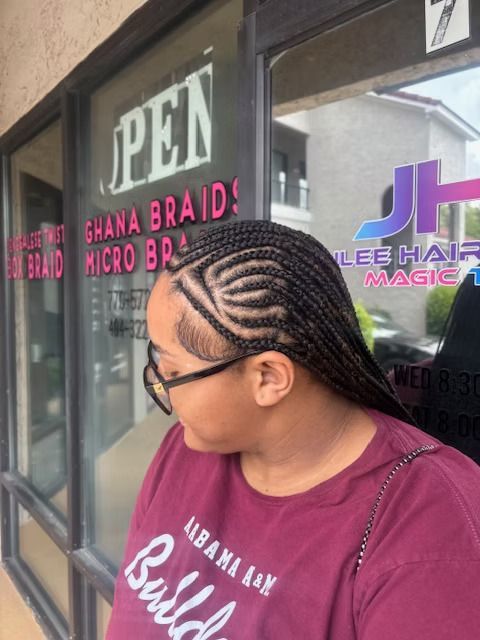
How the Feeding Technique Changes the Finished Look
Each braid starts with your natural hair, and small pieces of extension are folded in as the braid moves toward the ends. This creates a gradual thickening effect that looks more organic than a blunt start. In Union City, feed-in braids are installed with careful attention to how much hair is added at each fold to keep the braid uniform and lightweight.
Once finished, your hairline should appear clean and flat, with no visible knots or bumps where the extensions begin. Julee African Hair Braiding uses this method across a range of styles, including side parts, straight-back rows, and circular patterns for buns. Feed-in braids typically last two to four weeks depending on hair texture and how much new growth occurs at the root.
Maintenance includes nightly wrapping, light oiling along the scalp, and edge control to tame any flyaways that appear near the hairline. Avoid pulling the braids into tight updos during the first few days, as this can shift the feeding pattern. This service does not include ponytail holders, beads, or cuffs unless you bring your own or request them in advance.
You're likely comparing tension, appearance, and durability.
Feed-in braids offer a different feel and finish than traditional cornrows, and knowing what changes during installation helps you set the right expectations.
What makes feed-in braids different from regular cornrows?
Feed-in braids gradually add extension hair as the braid is formed, while regular cornrows typically start with all the extension folded in at the base, creating more bulk and tension at the root.
How long does a feed-in braid style take to install?
Depending on the number of braids and whether you're getting a ponytail or full head, expect between three and six hours for completion.
Why are feed-in braids better for thin edges?
Because the extension is added slowly, there's less weight anchored at the hairline, which reduces the pulling that can lead to breakage or thinning over time.
When should you take down feed-in braids?
Most clients remove them after two to four weeks, once new growth starts to disrupt the tapered look or when the scalp needs a break.
What is a feed-in ponytail?
A feed-in ponytail uses the same gradual braiding method to create cornrows that gather into a high or low ponytail, with the braid base looking flat and the ponytail having added length and fullness.
If your edges are recovering or you want a braid style that doesn't announce itself at the root, feed-in braiding offers a softer entry point with a polished result. Contact Julee African Hair Braiding by phone, text, or email to go over style options and set up your session.