
Signature Center Braids With Cultural Roots and Modern Appeal
Fulani braids installed by Julee African Hair Braiding in Union City combine a center braid, side cornrows, and decorative beads for a look that's both traditional and adaptable to your personal style.
You want a braid style that includes detail, symmetry, and the option to accessorize without looking overdone. Fulani braids are defined by a single braid or set of thin braids running down the center of the head, with cornrows on either side that curve back toward the crown or temples. In Union City, this style is installed using feed-in or traditional braiding methods and often finished with beads, cuffs, or cowrie shells along the length or at the ends.
The look is rooted in West African styling traditions and has been adapted into modern variations that include different braid thicknesses, part placements, and bead colors. You can request a minimalist version with just the center braid and a few side rows, or go for a fuller design with multiple cornrows, curves, and heavy beading. Fulani braids work across a range of hair lengths and textures and hold up well for both casual and formal settings.
To schedule Fulani braids in Union City, call, text, or email and mention whether you want beads included and what size or layout you prefer.
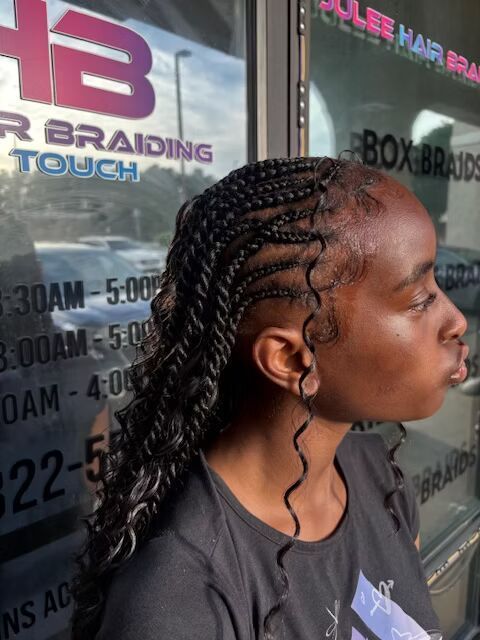
What the Installation Involves and How It Looks When Done
The braider parts your hair down the center or slightly off-center, then installs one or more thin braids along that line. Side sections are cornrowed in straight, curved, or angled rows depending on your head shape and the pattern you choose. In Union City, beads are typically added during the braiding process or threaded on afterward and secured with small rubber bands.
After installation, the center braid acts as a visual anchor, and the side braids frame your face while keeping hair off your neck and ears. Julee African Hair Braiding finishes the style by sealing braid ends and adjusting tension as needed to keep the design balanced. Fulani braids typically last two to four weeks, and the beads stay in place as long as the braid structure holds.
Care includes wrapping your hair at night to protect the beads and prevent the side braids from flattening. Apply light oil to your scalp weekly and avoid heavy products that can weigh down the center braid. This service does not automatically include beads or accessories, so confirm what's provided or bring your own if you have a specific look in mind.
You may want clarity on styling and upkeep.
Fulani braids offer room for customization, and understanding the structure helps you make choices about bead placement, braid size, and how long you plan to keep the style.
What defines a Fulani braid style?
Fulani braids feature one or more thin center braids running from the hairline to the crown or nape, with cornrows on the sides and often beads or rings woven into the design.
How long does it take to install Fulani braids?
Depending on the number of side braids and the amount of beading, expect between three and six hours for a complete style.
Why do Fulani braids include beads?
Beads add weight to the ends, help the braids hang straight, and serve as a decorative element rooted in the cultural origins of the style.
When should you remove Fulani braids?
Most clients take them down after two to four weeks, once the cornrows begin to fuzz or the center braid starts to loosen at the root.
What length works best for Fulani braids?
The style can be done on shoulder-length hair or longer, and extensions are often added to the center braid for additional length and definition.
If you're looking for a braid style with structure, symbolism, and room to add your own touches, Fulani braids offer a framework that works across occasions and personal preferences. Reach out to Julee African Hair Braiding by phone, text, or email to go over braid layout, bead options, and scheduling.